Set Your Writing Standards with "Edit Report Behavior"#
You can now instruct TensorCase to apply specific writing standards across your report outputs — for example, using non-U.S. spelling conventions or setting naming conventions.
How to set it up:#
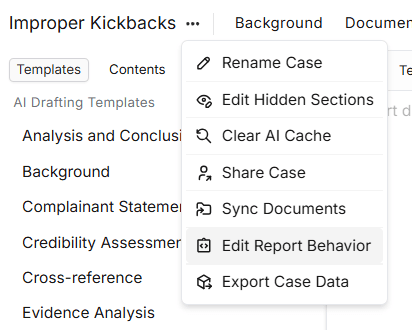
- Click the three dots next to your case name.
- Select Edit Report Behavior.
- Choose whether the instruction applies to all reports or this investigation only.
- Type your instruction and click Submit.
- Then, try generating a report to see your standards in action.
See screenshot below:
Sample instructions you can paste in:#
Canadian English: "Use Canadian English spelling conventions throughout (e.g., colour, labour, centre, analyse, defence, travelled, honour, metre, favour, catalogue, cheque, grey, practise as a verb, licence as a noun, realise)."
New Zealand English: "Use New Zealand English spelling conventions throughout (e.g., colour, labour, centre, analyse, defence, travelled, honour, metre, favour, catalogue, cheque, grey, practise as a verb, licence as a noun, realise, organisation, capitalise, apologise)."
Australian English: "Use Australian English spelling conventions throughout (e.g., colour, labour, centre, analyse, defence, travelled, honour, metre, favour, catalogue, cheque, grey, practise as a verb, licence as a noun, realise, organisation, capitalise, apologise)."
UK English: "Use UK English spelling conventions throughout (e.g., colour, labour, centre, analyse, defence, travelled, honour, metre, favour, catalogue, cheque, grey, practise as a verb, licence as a noun, realise, organisation, capitalise, apologise, judgement)."
Additional examples:#
Naming Conventions: "After introducing a person with their full name and title, refer to them subsequently using their prefix (Mr./Ms./Dr.) and last name only. Use consistent naming throughout each report."
Attribution and Sourcing: "Clearly attribute all information to sources. Use phrases like 'according to [name],' '[name] stated that,' or 'records indicate' rather than presenting information as established fact without attribution. Distinguish between direct observation, document review, and hearsay evidence in all statements."
Passive Voice Caution: "Use active voice to maintain accountability. Write 'Smith told Jones' rather than 'Jones was told.' Exception: use passive voice when the actor is unknown or when emphasizing the action over the actor."
Neutral Language Convention: "Use neutral, objective language throughout. Use 'said' or 'stated' for attribution. Avoid suggestive verbs that imply credibility, emotion, or judgment (e.g., avoid: claimed, admitted, confessed, alleged, insisted, argued, revealed, conceded, contended, maintained, asserted, declared)."
Alternative instruction for Neutral Language: "Use neutral attribution verbs. Default to 'said' or 'stated' unless legal precision requires specific terminology. When using verbs like 'admitted,' 'denied,' 'alleged,' or 'testified,' ensure they accurately describe the nature of the statement rather than implying judgment about credibility. Avoid editorial verbs that characterize the speaker's manner or intent (e.g., avoid: grumbled, snapped, pontificated, whined, gushed, boasted)."
Watch the quick walkthrough video to see how it works.